Rapid Acceleration of AI Integration
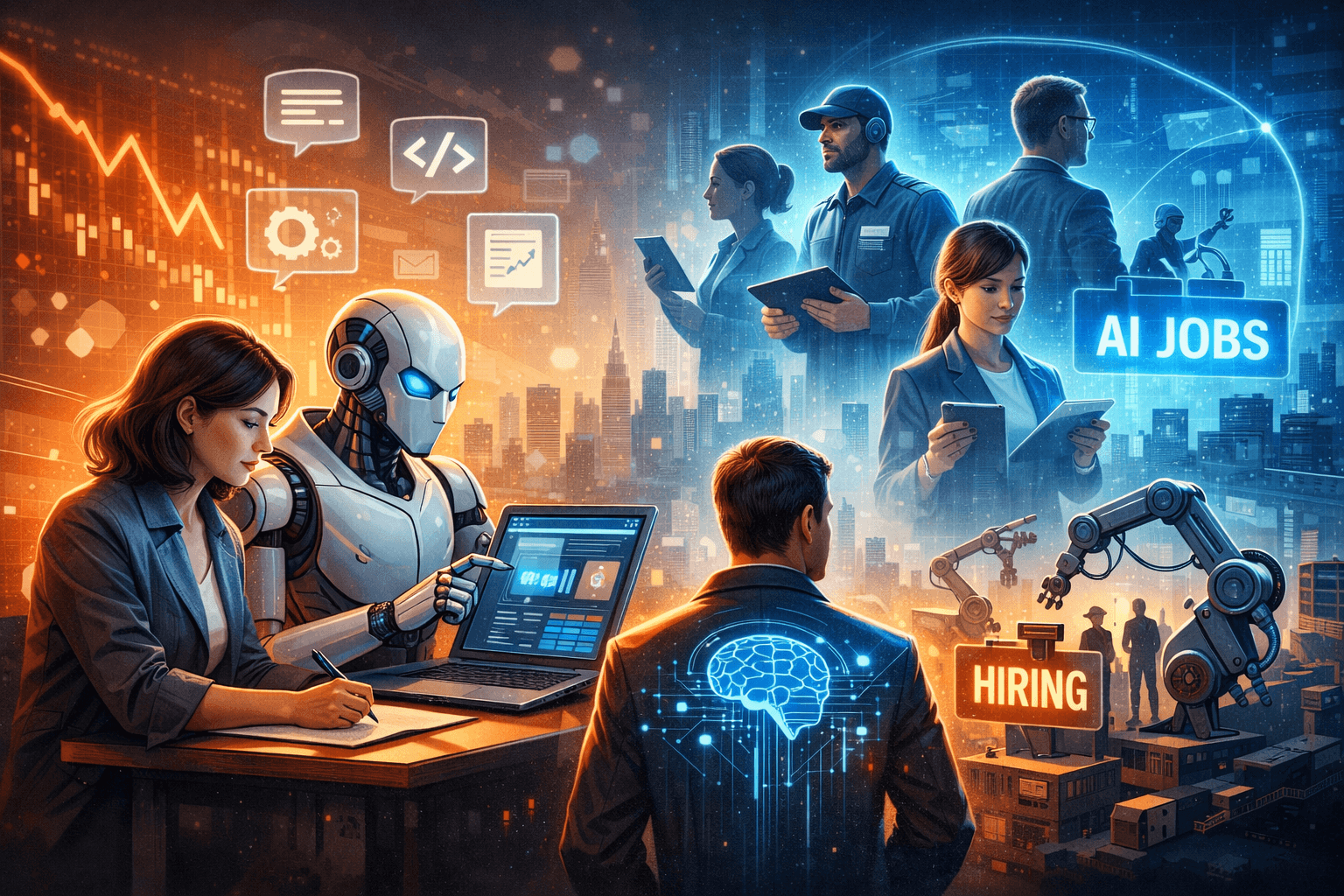
Over the next three months, AI adoption will deepen rather than broaden. Many companies have already experimented with AI tools; now they are moving into full integration. Expect to see AI embedded directly into everyday workflows—customer service platforms, internal communication tools, project management systems, and even hiring processes.
Generative AI, automation agents, and AI copilots will become standard in office environments. Rather than being optional tools, they will increasingly become expected components of productivity. Businesses that delay adoption risk falling behind competitors who are already optimizing operations with AI.
Immediate Impact on the Job Market
The job market will not collapse overnight, but it will noticeably shift. The most immediate impact will be task-level disruption, not full job elimination.
1. Automation of Repetitive Tasks
Roles that rely heavily on routine processes—data entry, basic customer support, scheduling, and simple content generation—will see rapid automation. Employees in these roles may find their workload reduced or redefined within weeks.
2. Job Transformation, Not Just Replacement
Many positions will evolve rather than disappear. For example:
Customer support agents will become AI supervisors.
Designers will shift toward creative direction while AI handles execution.
Developers will rely more on AI-assisted coding, focusing on architecture and problem-solving.
This shift favors workers who can collaborate with AI rather than compete against it.
3. Surge in Demand for AI-Skilled Workers
There will be an immediate spike in demand for individuals who understand how to use, manage, or integrate AI tools. This includes:
Prompt engineers
AI product managers
Data specialists
Automation consultants
Even non-technical roles will require basic AI literacy.
Short-Term Hiring Trends
In the next three months, hiring patterns will reflect urgency rather than long-term strategy:
Companies will pause hiring in roles they believe AI can partially handle.
Contract and freelance work will increase, especially for AI-related implementation.
Hybrid roles will emerge, combining traditional skills with AI capabilities (e.g., “AI-assisted marketer” or “automation-focused operations manager”).
Employers will prioritize adaptability over experience alone.
Economic and Workplace Shifts
AI will also influence how work is structured:
Productivity expectations will rise: With AI tools accelerating output, companies may expect more results from fewer people.
Smaller teams will achieve more: Startups and small businesses will gain leverage, competing with larger organizations using AI efficiency.
Decision-making will speed up: AI-driven insights will reduce the time needed for analysis, pushing companies toward faster execution cycles.
Risks and Uncertainty
The speed of AI adoption introduces challenges:
Job insecurity may increase, especially in roles vulnerable to automation.
Skill gaps will widen between workers who adapt quickly and those who do not.
Over-reliance on AI could lead to quality or ethical issues if not properly managed.
Organizations that fail to balance human oversight with automation may face operational risks.
What Workers Should Do Now
The next three months are a critical adjustment period. Workers who act early will have a clear advantage. Key steps include:
Learning how to use AI tools relevant to their field
Focusing on uniquely human skills such as creativity, leadership, and critical thinking
Staying adaptable and open to role changes
Building a personal workflow that incorporates AI rather than avoids it
Conclusion
The next three months will not bring a dramatic collapse of the job market, but they will mark a clear turning point. AI will move from being an experimental advantage to a baseline expectation. Jobs will evolve quickly, and the gap between those who embrace AI and those who resist it will become more visible.
In this short timeframe, the future of work is not about replacement—it is about reinvention. Those who learn to work alongside AI will not only remain relevant but may find themselves ahead in a rapidly transforming economy.